

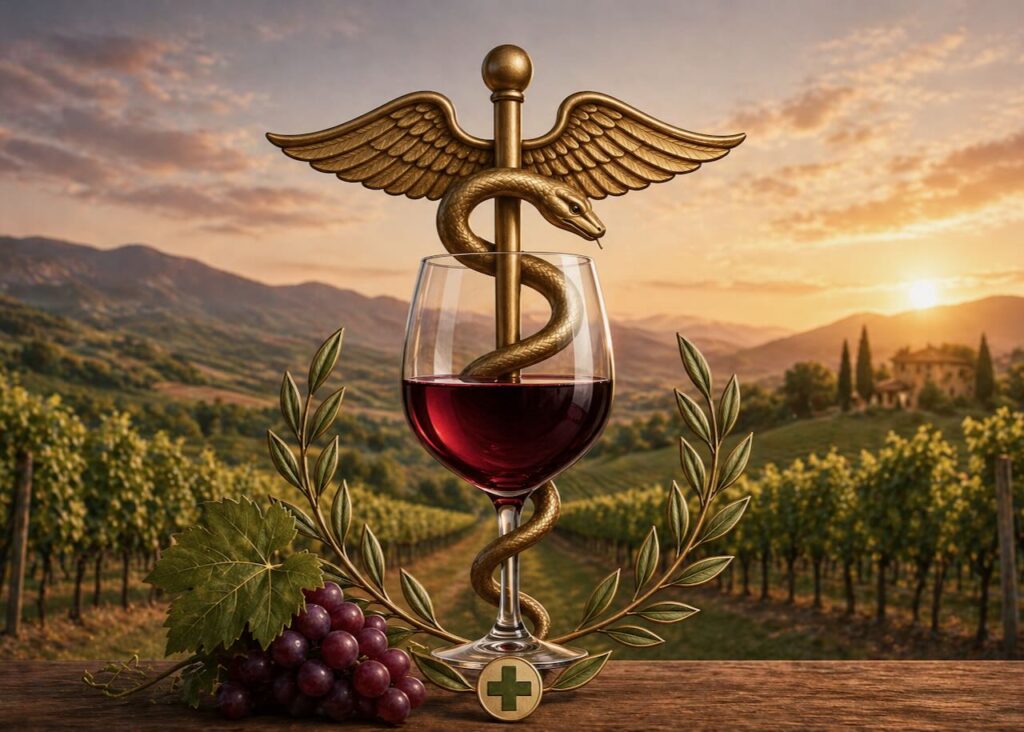
Is Drinking Wine Hazardous to Your Health?
The answer is complicated, yet nuanced. It will vary depending on an individual’s perspective. Then I came across this recent article: “Young doctors nearly killed me, because in their phrasing, I use alcohol.”
This is a quote from wine writer W. Blake Gray in the publication Wine-Searcher, titled “Alcohol Caught Between Science and Ideology.”
In summary, the article recounts a harrowing eight-day hospital stay where Gray felt his life was endangered by the biases of younger medical professionals. While older doctors provided nuanced care and acknowledged the potential cardiovascular benefits of his moderate wine consumption, younger staff strictly followed unscientific “no safe level” guidelines and labeled him a “user of alcohol.” This ideological pigeon-holing led to judgmental treatment, a dismissal of his intense pain, and a delayed diagnosis of his actual condition.
This is strong stuff.
Why are we now more commonly coming across positions that “any” level of alcohol consumption is bad for your health, which clearly influenced how young doctors treated a patient in this illustrative example?
First, to help get a grip on the levels of wine consumption commonly used by medical professionals, let’s distinguish among no alcohol consumption, low- to moderate levels, and heavy or excessive consumption. I’ll start with low to moderate, which is commonly used as a reference point in tests and studies. It is defined as 1 5-ounce glass of wine (about 1 beer or 1.5 ounces of 80-proof spirit) per day for women, and 2 similar glasses per day for men, not exceeding 7-14 drinks per week.
Heavy and excessive consumption is a daily amount that exceeds low- to moderate-level thresholds, while no consumption is, well, as it sounds, zero alcohol.
Another factor at play when drinking alcohol with food, especially wine, as is often done, is that the act lowers blood alcohol levels. Additional wine, within reason, associated with a meal can still be considered below the threshold for excess.
Second, let’s review recent studies and recommendations.
There are two major conflicting US reports regarding alcohol consumption and health. There are also additional studies with diverse conclusions and recommendations, especially when considering wine versus other alcoholic beverages such as beer and spirits.
A 2023 report, which began the more recent strict examinations by the Interagency Coordinating Committee on the Prevention of Underage Drinking (ICCPUD), claimed that low levels of alcohol consumption increase the risk of death, i.e., there is no safe level of alcohol consumption.
Many have argued the ICCPUD panel was biased, lacked transparency, and was comprised of addiction specialists with “neo-Prohibitionist” leanings.
In close conjunction with ICCPUD’s report, several prominent health organizations, including the World Health Organization (WHO) and the U.S. Centers for Disease Control and Prevention, adopted strong anti-alcohol positions. Many health institutions quickly followed suit.
Due to strong counter-reactions from industry and public sources, who were concerned that the new strong anti-alcohol positions were politically biased, Congress asked the National Academies of Sciences, Engineering, and Medicine (NASEM) to review the available literature and studies on the issue. The NASEM’s report concluded that moderate drinking reduces all-cause mortality. In summary, while moderate drinking raises your risk of several types of cancer, notably breast cancer, it also reduces your risk of heart disease (and stroke), which is the number one killer of Americans.
The topic can be further assessed to determine whether wine poses a lower risk than drinking beer or spirits. And to take matters a step further, if there is a health difference between drinking white and red wine. Without getting too much in the weeds, several studies have found that wine is healthier than beer and spirits, and that red wine is generally healthier than white.
Third, and back to the original basis of the examination, is why the morass of complex and at times conflicting reports in a fairly short period of time is leading, at least in this illustrated example, to inferior health care by medical providers?
You can look beyond the growing body of information to find a deeper meaning. Possibly, younger professionals, as in Gray’s personal telling, haven’t had that opportunity, i.e., a lack of both professional and personal experience that, in time, brings more nuanced wisdom, away from strict dogma. Strict medical dogma also doesn’t account for how wine is often a social, creative, and liberating experience that, more often than not, enhances life; a healthy endeavor in most cases, if not abused.
So, let the debate continue, but for me, I’ll continue to find joy in my ongoing life of learning, growing, and creating wine, which I have no doubt will enrich my days yet to come.