

A Day in the Life - Harvest 2026
From the first grape clipped to the last piece of equipment cleaned, a day in the vineyard turns 225 pounds of Pinot Noir into the promise of rosé.
At the beginning of September, the end of the grape-growing season is near. The vines have weathered a March heat dome, April freezes, pesticide drift, fungal spores, relentless pruning and spraying, birds, winged stinging insects, and hungry mammals.
After all the hard work by both man and vine, it’s finally time to reap the harvest.
What are the steps involved in the season’s final act?
First up: timing. Determining when to harvest. My approach involves monitoring three factors: Brix (the sugar level in the grapes), acidity, and flavor. Having monitored the grapes since mid-August through testing and tasting, I knew my Pinot Noir was ready by September 1.
They were ready earlier than usual, thanks to spring’s early start, dry conditions, and a consistently hot summer. There was another consideration as well: I planned to make rosé, which calls for harvesting at a lower sugar level than I might target for a traditional red wine. The result promises a wine with lower alcohol, fresh aromas, a lighter body, and a crisp, satisfying finish.
Just what I had in mind for my ideal rosé.
Second up: harvest. September 2 was the day. It was going to be a long one because after harvest, the grapes needed to be crushed and destemmed, soaked for three to four hours, pressed, and transferred to appropriate containers to settle overnight.
The day began at 6:00 A.M.
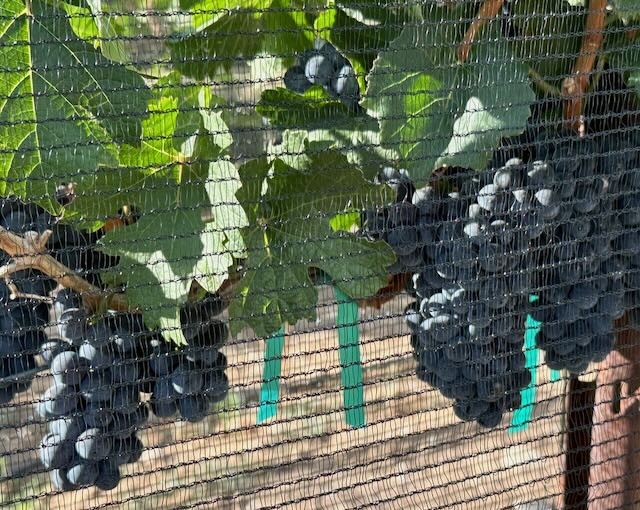
The bottoms of the insect nets had to be untied, lifted, and secured to an upper trellis wire to provide access to the grape clusters. For context, my vineyard consists of 80 Pinot Noir vines spread across nine rows of varying lengths. Approximately three-quarters of the vines bore fruit; the remaining are younger that haven’t yet reached fruit-bearing age.

With the nets taken care of and a quick breakfast under my belt, I was harvesting by 8:30.
Clipping the clusters and placing them in five-gallon buckets is fairly straightforward. I carefully examine each cluster and discard those that are underdeveloped or damaged by wildlife. Reaching into the vine canopies to retrieve partially hidden clusters can be a challenge. Accidentally clipping a fingertip or scraping the backs of my hands are occupational hazards. Apparently, grapes don’t always give themselves up without a little bloodshed.
225 pounds of grapes were harvested by 11:30.
Third up: crush and destem. As you might imagine, there’s an ominous name for the machine that does the job: the monster truck wannabe, the Crusher-Destemmer.
Mine is electronically powered. It first crushes the clusters between rubber rollers, breaking the grape skins. A rotating drum then separates most of the stems from the grapes.
The resulting mixture of crushed grapes, juice, skins, and seeds is called must.
This step was complete by 2:00.

Fourth up: soak the must. Soaking allows the ruptured grape skins to impart color to the juice. The longer the contact, the deeper the color.
I was aiming for a lighter shade—think salmon flesh. Three and a half hours of skin contact was on the docket. I knew this from past Pinot rosé-making escapades. At the start of the soak, I also added a small amount of sulfite to help control unwanted wild yeasts and oxidation.
Fifth up: press the must. This was the final step of the day, and with the sun lowering in the sky at 6:00, it was time to get moving.
First, I had to set up the press and prepare six and five gallon carboys—winemaker jargon for containers—to collect the juice. My press uses a cylinder rubber bladder that expands using water pressure, pressing the grapes against a fine stainless-steel mesh. The juice flows through the mesh and into an awaiting bucket, leaving the skins and seeds behind.
By dusk, the job was complete resulting in 16 gallons of freshly pressed juice. Then came cleanup, which took another hour.
By 8:00, everything was done.
But the juice wasn’t ready to begin fermentation just yet. Freshly pressed juice contains suspended solids that need time to settle to the bottom of the carboys. These solids after pressing, are known as gross lees. They needed to settle before I racked—another fancy winemaker term for transfer—the juice sans gross lees, to another set of carboys for fermentation. The settling process takes approximately 24 hours.
So, who deserves the star billing for the day?
Sanitation, the unsung hero of winemaking.
It’s not often discussed in conversations between winemakers and consumers, but thorough sanitation is essential to making good wine. And it takes a lot of effort and time. Everything that comes into contact with the grapes, must, or juice must be properly cleaned and sanitized. After use, the equipment needs to be hosed down and cleaned, and put away.
It’s not glamorous, but neither is spending months making wine only to have it spoiled by something that could have been prevented.
After a 14-hour day processing grapes, you can feel the results in your bones and aching muscles. Yet there’s a genuine sense of fulfillment and accomplishment. The grapes have been harvested, the juice is safely tucked away, and another growing season has come to an end.
It’s the kind of day that makes all the work worthwhile.

But don’t break out the wineglasses just yet.
The harvest may be over, but the winemaking journey is only beginning. In the days and months ahead, there will be fermentation to monitor, wine to rack, and plenty of decisions to make along the way. Eventually, after more work, patience, and perhaps a few surprises, the goal is to have a finished rosé ready to enjoy by the following summer.
And that’s the beauty of my Wine Encore. Every season brings a harvest, every harvest brings a new set of challenges, and every bottle tells a story about the work that went into it.
Now, if you’ll excuse me, I have some equipment to clean.