Chromotagraphy Result Sheet

In the Wine Lab (WineMaker)

Sooner or later, if you make wine at home, you are going to do some chemical analysis. There are some tests that are absolutely essential to any complete winemaking program, others that are informative but optional, and some that are mostly curiosities. Among all the tests, some of the equipment is required, some of it can be done without, and some of it goes on the birthday wish list for someone else to buy for you.

In the Wine Lab (WineMaker) Read more...
Sniffing wine

Acidity and pH (Australian Wine Research Institute)

Why is pH important? The pH of juice or wine is important to know as it plays a critical role in many aspects of winemaking, in particular wine stability. Boulton et al. (1996) writes that pH influences microbiological stability, affects the equilibrium of tartrate salts, determines the effectiveness of sulfur dioxide and enzyme additions, influences the solubility of proteins and effectiveness of bentonite and affects red wine color and oxidative and browning reactions.

Acidity and pH (Australian Wine Research Institute) Read more...

Understanding the Basics of pH Meters (WineMaker)

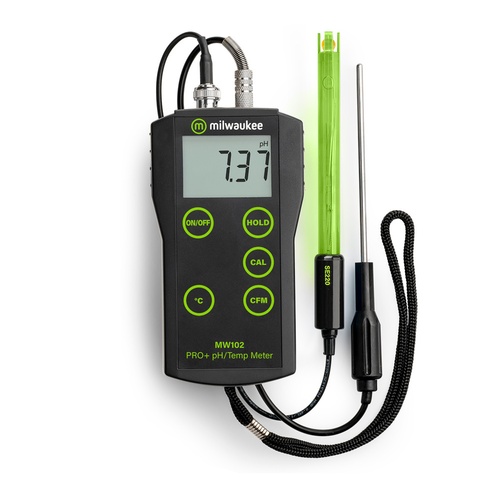
After some convenience items like a racking cane and a wine thief are added to your winemaking equipment arsenal, a quality pH meter should be one of your next investments. Being able to get an accurate read on where your wine’s pH lands on the spectrum has huge implications not only for flavor and balance but more importantly its microbial stability and impact on sulfite additions. It is probably the single most important number you can obtain while making wine.

Understanding the Basics of pH Meters (WineMaker) Read more...

Managing Sulfites in Wine (Smart Winemaking)

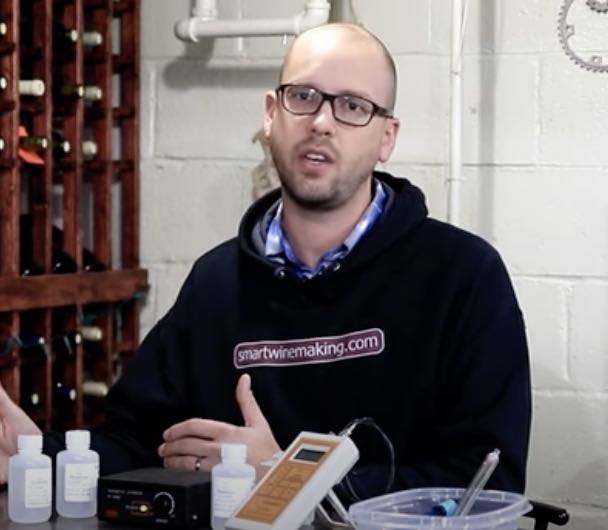
In winemaking, SO2 is the first line of defense against oxidation and microbial spoilage and a key contributor to a wines aging potential. As a winemaker, you are intentionally allowing the fruit juice to decompose into wine (thank you yeast!), but stopping it before it continues the decomposition cycle to volatile acids like vinegar and then later into water, as would happen in nature.

Managing Sulfites in Wine (Smart Winemaking) Read more...

Measuring TA in a Wine with a pH Meter (The Home Winemaking Channel)

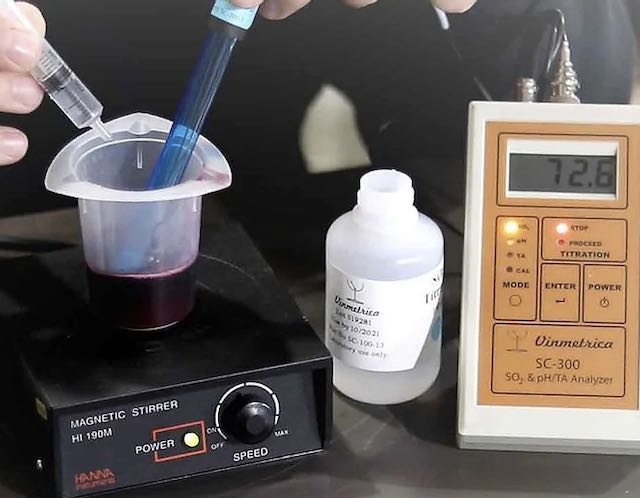
This seven-minute video, shows a titration method of measuring TA in a wine but rather than using an indicator solution and a visual color change, we are using a pH meter to verify when enough NaOH has been added to reach a pH of 8.2. Once the amount of sodium hydroxide needed is known, a simple calculation can tell you the TA of your wine. This method is easy to do at home.

Measuring TA in a Wine with a pH Meter (The Home Winemaking Channel) Read more...

Testing

Malolactic Chromatography Testing (MoreWine!)

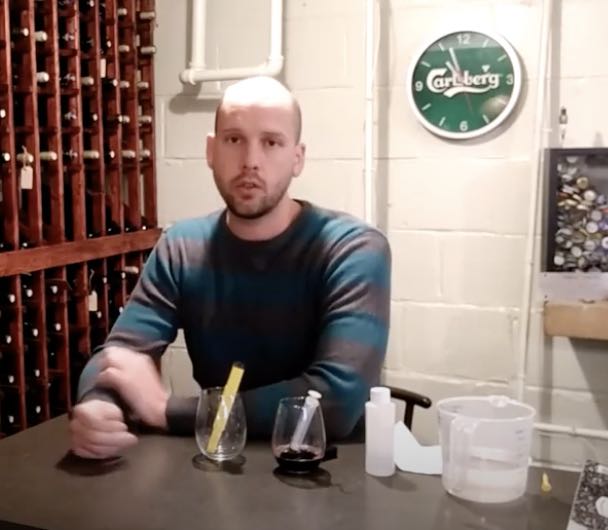
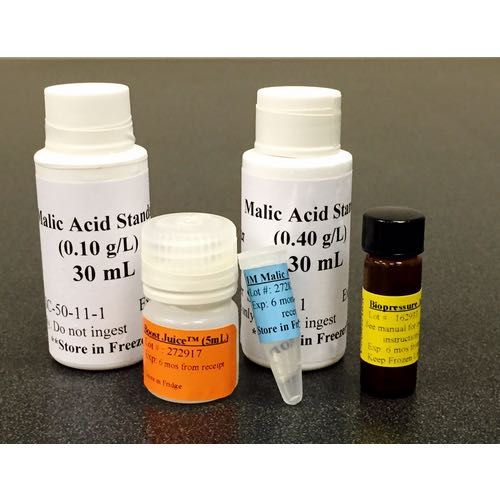
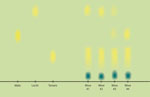
Malolactic fermentation (MLF) is a winemaking process involving a special bacterial strain that metabolizes the malic acid naturally found in grapes into lactic acid. Lactic acid is a weaker acid than malic acid so the effect of this conversion is a decrease in the wine’s acidity along with a corresponding raise in the wine’s pH. As an additional benefit, the bacteria also add mouthfeel and complexity to the wine.

Malolactic Chromatography Testing (MoreWine!) Read more...

Scroll to Top