

A Whiff of Danger
Wine may be romance in a bottle, but getting there can be a messy, and occasionally dangerous, business
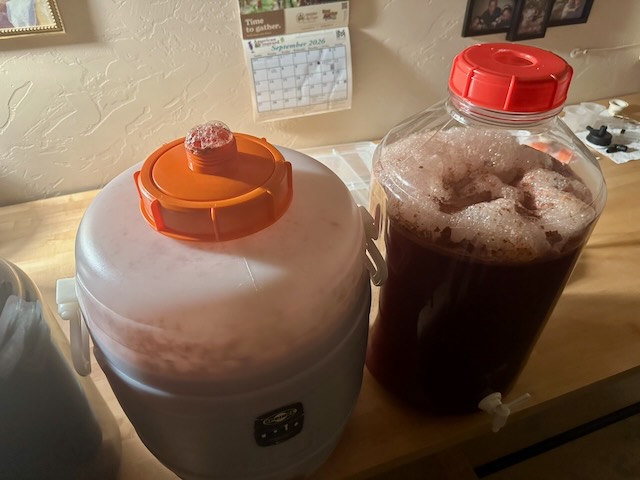
Twenty-four hours after harvesting and processing my Pinot Noir grapes destined for rosé greatness this season, I pitched the yeast and started the juice fermenting.
Two days later, as fermentation roiled away, the two vessels filled the winery with an acrid, pungent smell commonly referred to as “fermentation funk.”
The smell that makes life worth living to me, was a headache in the making for my wife, Janine.
The funk is a combination of several elements: the bread-like aroma of yeast, fruity esters, the prickly sensation of escaping carbon dioxide (CO₂), and, occasionally, the smell of rotten eggs produced by sulfur compounds.
Of these elements, CO₂ has no smell. What you experience as it rushes out of vigorously fermenting juice is more of a physical sensation—a sharp, stinging feeling in the nose and throat.
A sensation not unlike as a kid when I stuck my nose over a pot of Aunt Mary Jane’s boiling pickling juice. It’s not like she didn’t warn me.
On a more sobering note, early in the wine-production season, it is not unusual to see headlines about someone dying of asphyxiation in a winery. During fermentation, yeast converts sugar into alcohol and CO₂. In the winery, especially with larger commercial operations, that CO₂ can accumulate in poorly ventilated areas, displacing oxygen. A person entering such an environment can become unconscious without much warning.
There are also documented cases of winery workers punching down the fermentation cap—a layer of grape skins and solids floating on top of red wine as it ferments—passing out from CO₂ exposure, and then falling into the vat and drowning.
Having just read about such an occurrence and reflecting on my small operation and current state of 13 gallons of fermenting funk, my curiosity grew about the types and levels of casualties associated with wine production.
As it turns out, there isn’t a single international database that tracks vineyard and winery accidents. However, accident and occupational-injury data are compiled by various locales, industry associations, and agencies such as the U.S. Bureau of Labor Statistics and the UK’s Health and Safety Executive.
In the vineyard, the principal ranked categories of injuries include:
Transportation and equipment; tractor rollovers on slopes, and workers being struck or run over by equipment.
Contact with objects and machinery; crushed by equipment, caught in machinery, and cut by pruning tools.
Environmental; excessive heat and chemical exposure.
In the winery and cellar, the hazards shift:
Atmospheric asphyxiation; CO₂ accumulation during fermentation.
Machinery and equipment; crushing, entanglement, and other serious interactions.
Falls from heights; from catwalks, platforms, ladders, and tanks.
So, I suppose there is an advantage for a hobbyist like me in not being a larger operation with multitudes of workers and equipment to manage, but it’s not like there aren’t inherent dangers in my solitary work as a winemaker.
At least once during every harvest I clip a finger, or two, with my pruning shears while extracting partially hidden grape clusters within a vine canopy. Further, yellow jackets aren’t specifically called-out as a casualty category but take my word for it, after a long day of sugar laden grape processing, you and the equipment become prime Fruit Roll-Up targets.
Don’t get me started on my lower back.
These episodic situations are a particularly grim reminder that making wine isn’t quite as benign as its romantic image might suggest!