

What Role does Acid Have in Wine?
A recent Substack post by Meg Maker, who is writing a glossary she titles Abecedaria, defines important concepts in wine and gastronomy. “A” is first on the list of course, and first on the block was Acid.
Meg begins by identifying the two types of acid, fixed and volatile. She writes: “fixed acids give a wine structure, texture, and zing, while volatile compounds are picked up aromatically.”
About the same time I came across her new developing glossary, I was assessing two of my wines, asking the all-important question whether they required “tweaking” before bottling.
The Pinot Noir Rosé was in great shape. With a lower alcohol content at 10.5 ABV (alcohol by volume), it has a light ruby color, a fresh cherry nose, a medium body, and a clean finish.
Ready to bottle as is.
The Riesling and Gewürztraminer field blend was nearly there, with a beautiful grapefruit nose, a bright straw color, a medium body, and a sharp finish. A bit too sharp in my estimation. The reason for the sharpness was a combination of high acidity, with a low pH. Not totally uncharacteristic of both grapes.
A casual drinker might find the wine too dry, lean, and a touch astringent.
What might correct the perceived sharpness caused by the acidity?
Time could. Over a year or two, as the wine ages, the acid tends to precipitate out, and the fruit characteristics mellow, leaving a more rounded wine.
Added sugar can correct the perceived sharpness. In the winemaking world, this is called “backsweetening”. In a taster’s mouth, sugar counterbalances the acidity, reducing the perception of sharpness.
Backsweetening is the tack I decided to pursue. It’s quick and easy, making the wine enjoyable to drink much sooner than if you wait for it to mellow. Although I had to be careful.
First, adding too much sugar can throw the wine out of balance, making it overly sweet and cloying. I didn’t want the drinker to sense the sugar. Second, adding sugar this late in the wine’s development could cause the remaining yeast cells to revive after bottling, resulting in re-fermentation, fizziness, off-flavors, and, heaven forbid, popping bottles or corks.
Two additives could prevent such occurrences: sulfite (at low, below-perception levels) and potassium sorbate.
Conducting a taste trial, I found the right amount of sugar to add.
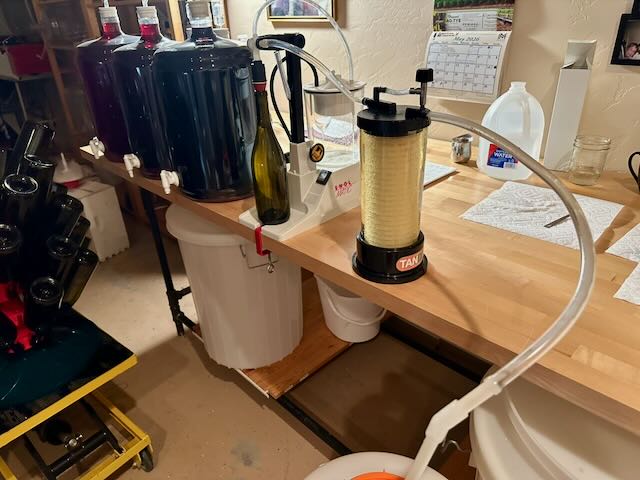
Suffice it to say, after tweaking the Riesling Gewürztraminer blend, I proceeded to bottle both wines. They now rest in my version of a cellar, the water cistern room, where it stays at a cool, constant temperature.
Perfect for summer quaffing, with crisp, balanced acidity, both wines will be ready to drink by the end of June, just in time for America’s 250th anniversary.